
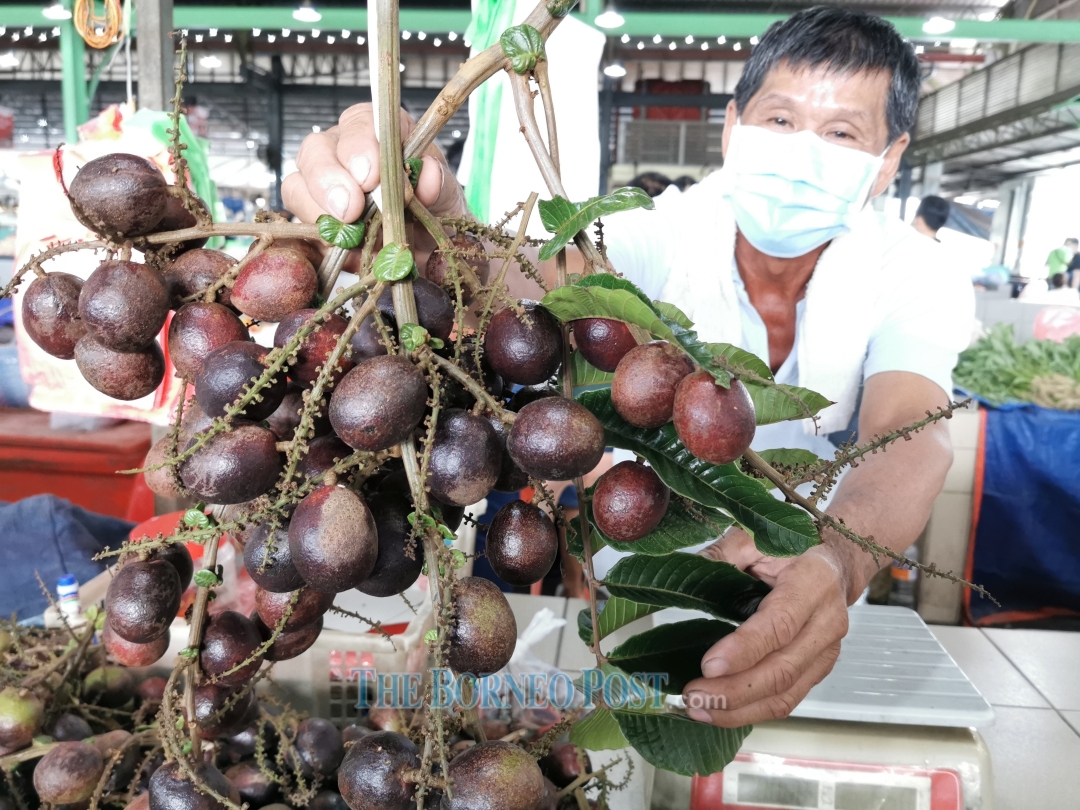
Vun Boon Fatt, 63, a trader at Bandar Riyal Market in Kota Samarahan, shows a bunch of ‘buah kristal’. The fruit also comes with many names such as ‘crystal longan’, ‘crystal lychee’ or ‘dragon’s eyes’. At the market, the price of ‘buah kristal’ ranges between RM10 and RM12 per kilogramme. — Photo by Roystein Emmor
THE Brazilian Crystal Longan is an addition to Sarawak’s long list of local favourites during the fruiting season.
A seasonal exotic fruit originating from South America, this variety is already naturalised in our midst already. It was brought here by one officer attending a conference some 30 years ago and after that, we heard about some timber workers also having it in Sibu.
Nonetheless, this species has been cultivated across many parts of Sarawak, as the plant finds the tropical climate very suitable.
The word ‘crystal’ in the name represents the fruit’s juicy, transparent flesh.
I have planted three trees in my orchard, and they start to bear fruits now.
My blacksmith dealer friend, however, has planted 40 Crystal Longan trees, which produce fruits of various sizes. According to him, the largest fruit is about the size of an egg, from the tree at his worker’s farm along Quap Road near Kota Padawan.
A bunch is now selling at between RM8 and RM10 per kilogramme.
This ex-colleague of mine sells the longans via WhatsApp too!
A fruit of many names
The Brazilian Crystal Longan is also known as the ‘Fijian Longan’ or ‘Poetia Pinnata’.
An indigenous variety called ‘Mata Kuching’ (Cat’s Eyes) can be found growing wild in the jungle.
However, the majority of them are being planted along the Upper Rejang and genereally, they come out as two varieties – the green or brown-husk ‘Mata Kuching’ (Dimocarpus spp malesianus) as the flesh with the embedded black seed would appear after de-husking. Some other sources say the fruit is from the Sapindaceae family and native to the tropical South East Asia and Melanesia.
The tree is about 40m tall and has pinnate leaves.
The fruit can be either green, yellow or dark red out – measuring up to 4cm in length, with one seed surrounded be a fleshy aril (outgrowth). It resembles a lychee or a typical longan, somewhat.
The fruit is touted to be a natural remedy or a tonic to increase energy, boost the body’s immune system, help reduce stress and depression, enhance one’s memory and also, to act as anti-venom for snake bites.
The Fijian Longan, on the other hand, has several benefits like helping to counter insomnia and also anaemia.
Perhaps the most interesting property is anti-ageing! With its anti-oxidant compounds, it is also claimed to have insulin-sensitising (ability to lower blood sugar) potential.
Differences between Mata Kuching and Fijian Longan
It was once a trending urge amongst local fruit planters to cultivate longans in Sarawak upon witnessing how easy they were produced in Thailand and China.
However, it is only after several years of trials and research works by the Department of Agriculture that it has become ‘climatically and horticulturally possible’ to grow the fruit in this region. The private sector has had it grown using imported budded materials.
The longan (Dimocarpus longan) is spherical to ovoid in shape, with brown, thin and rough shell – some types have prickly exterior. Also called ‘Dragon’s Eyes’, the fruit has a single, shiny-brown round seed, while its white, translucent flesh has a delicate favour that nicely balances out sweetness and acidity.
Generally, we would eat longans raw, but cooking can help maintain the delicate favour.
Dried Dragon’s Eyes has an ‘intriguing, smoky flavour’ – the main reason it is amongst the main ingredients of the traditional herbal drink.
Those processed and sold in cans are the ones we would usually get from Thailand and China during the festive seasons.
I have planted the local variety of the Sibu origin – the one with the green rough shell. Fruiting, however, get irregular at times, unlike the typical longan, which bears fruit every year.
Regardless, this is one of those favourite fruits that one would not stop eating until the stomach is truly full.
To enjoy a Brazilian Crystal Longan can be a bit tricky, especially for the ladies – perhaps the best way for them is to crack open the fruit using a nutcracker, or a small mallet.
My blacksmith dealer has taught me his way of doing it – by placing two longans in the palms of both hands, and cracking them against each other using the force from the palms.
It appears to work for him, but indeed – one must have muscular palms with kung-fu-level strength just to be able to enjoy the fruits!
Funny stories aside, let us plant one so as to be able to reap the sweet rewards in the future.
Happy Gardening!
from Borneo Post Online https://ift.tt/3zuAmbS
via IFTTT

No comments:
Post a Comment